How to Launch a Brand Fast: What Actually Makes It Possible
Most clients come to us with a real deadline. A funding announcement. A trade show. A product launch that can’t move. The conversation usually starts the same way: “We need this by [date].” That’s not the hard part. The hard part is what happens next.
The real reason brand launches are slow
It’s almost never the creative work.
Timelines slip because process drags. Because three vendors are handing files to each other across email chains. Because the brief wasn’t right when design started, so the work has to be re-done. Because everyone reviews everything at every stage, and no single person has authority to say yes.
The logo, the site, the visual system: the creative itself often takes less time than the approval loop around it. That’s the problem most agencies don’t talk about because it implicates the client as much as the agency.
What has to be true before speed is possible
Fast brand launches require two things: the right team structure and the right client structure.
On the team side, the difference is whether strategy and execution live in the same room. When there’s no handoff between the strategist, the designer, and the web builder, decisions happen in real time. Context doesn’t get lost. Work doesn’t come back with a question that should have been answered three weeks ago.
On the client side, what makes it work is clear decision-making authority. One or two people who can say yes. A real deadline they’re not willing to move. And enough trust in the process to not restart from scratch when the first direction isn’t quite right.
Both sides have to show up. When they do, fast is realistic.
The Brand Launch Kit: front-load the thinking
Our process for fast brand launches runs in four phases, each gating the next.
The first is Brand Therapy, a focused 60-minute session with the founding team. No design, no deliverables yet. Just the hard questions: What does this company actually need to say? Who are we talking to? What has to be true about how we look and sound? The output is a foundation document. Everything that comes after is built on it.
The second phase is Brand Identity: moodboards, logo directions, type system, color, visual language, guidelines. This is where the brand becomes something you can see. Because the strategic foundation was solid, we don’t go in five directions and iterate endlessly. We go in two or three intentional directions and make a call.
Phase three is Applications: taking the identity into the real world. Collateral, the homepage, key brand moments. This is where you find out if the brand system actually works or if it needs adjustment.
Phase four is the Webflow site, with integrations. HubSpot. GA4. The infrastructure a company needs to be operational at launch, not two weeks after.
MVP first. Comprehensive later. Each phase gates the next so there’s no re-doing work that should have been decided upstream.
The hidden time-killer: wrong sequence
The most common mistake isn’t going too fast. It’s starting the wrong thing first.
Design begins before strategy is done. The website starts before the brand is locked. Or the whole team reviews every decision at every stage instead of letting the right people make calls at the right moments. Each of these adds weeks.
Sequence is the real leverage point. When the foundation is done before the identity starts, and the identity is done before the site starts, work flows in one direction. There’s no rework because the brief changed, or because the stakeholder who wasn’t in the room had a different vision.
Front-loading the hard thinking feels slower at the start. It’s what makes everything else fast.
When the deadline is real, everything gets clear
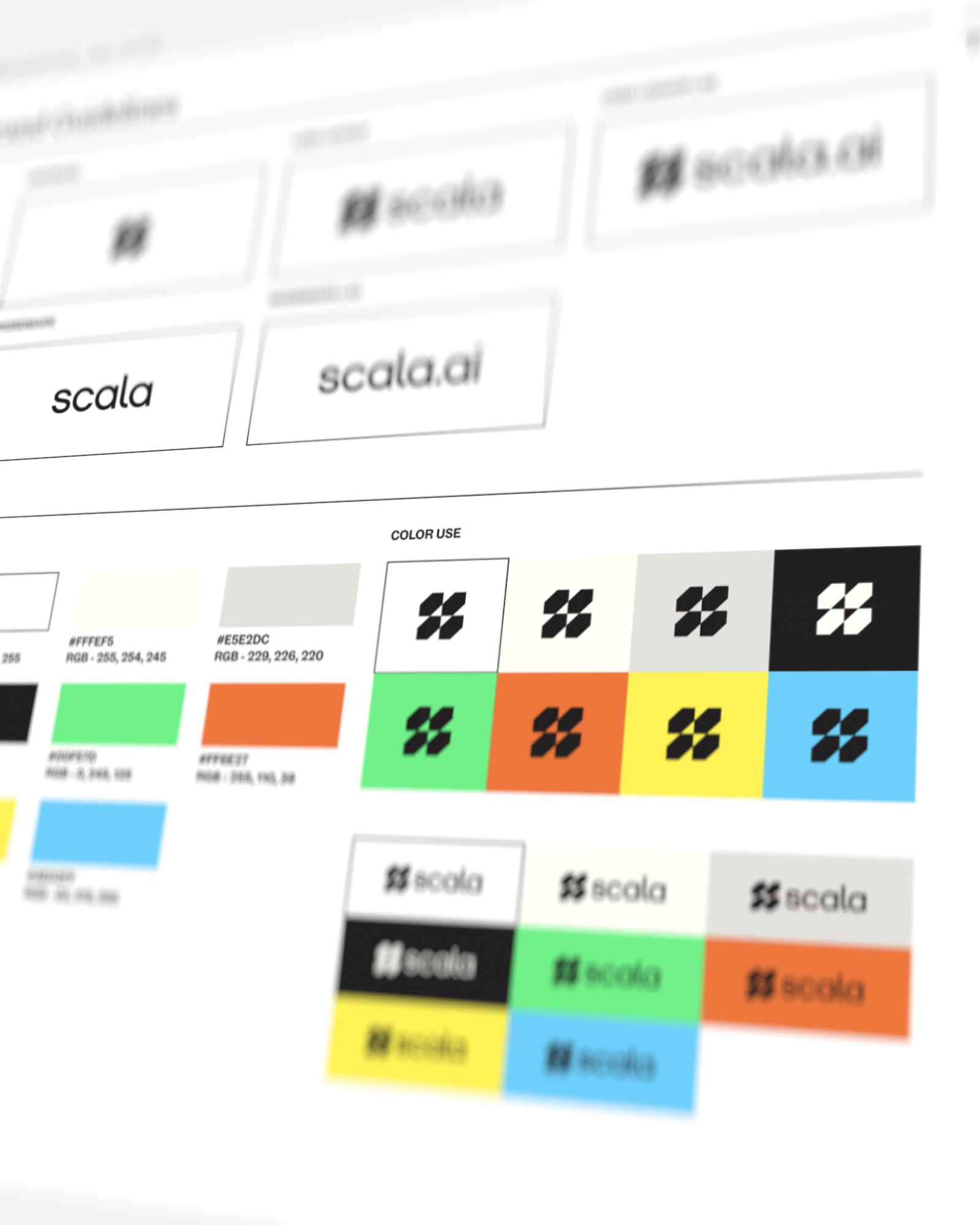
SCALA.AI is an AI platform for contact centers, backed by the co-founders of Concur. CEO Ardie Sameti had a seed round closing. The announcement was going out. The brand had to be ready.
We went from zero, with no name recognition, no visual identity, and no web presence, to a full brand system and live Webflow site in roughly 10 weeks. HubSpot and GA4 were operational at launch. The brand was live when GeekWire covered the $8.5M seed round.
Ardie’s take: “You guys are the real deal.”
No miracle involved. That’s what happens when both sides are locked in. SCALA.AI came to the table with clear decision-making, a deadline they couldn’t move, and no appetite for endless deliberation. We came with a process designed for exactly that situation.
The same model has since been applied to other clients, including Topcon. The playbook works because it’s built around the constraint, not in spite of it.
Stakes create focus
The best engagements we’ve had share a common trait: the deadline was non-negotiable.
Real stakes change the dynamic on both sides. The client stops deliberating and starts deciding. The team stops exploring and starts building. There’s less second-guessing because there’s no time for it, and often that turns out to be a feature.
This isn’t an argument for artificial urgency, just an observation about what focus requires. When the trade show opens on February 2, the work gets done. That was the case for AIIR’s AHR Expo booth, a full 10-by-20-foot trade show experience we designed and delivered in a tight window before AHR Expo 2026. The constraints that feel like a problem are often what make the work sharper.
What “fast” actually looks like
Zero to full brand identity, Webflow site, HubSpot, and GA4 in about 10 weeks. Brand live and credible at the moment of a major funding announcement. That’s the standard we built toward with SCALA.AI, and it’s replicable when the conditions are right.
Not every brand launch can move this fast. If the founding team hasn’t aligned on what the company stands for, the Brand Therapy session will surface that, and it’ll take longer to resolve. If there isn’t a single decision-maker, approval cycles will slow things down regardless of how efficiently we work. We’re not going to promise a timeline we can’t deliver.
What we can promise is a process that removes the avoidable delays, and a team that doesn’t lose anything in translation between strategy, design, and execution.